
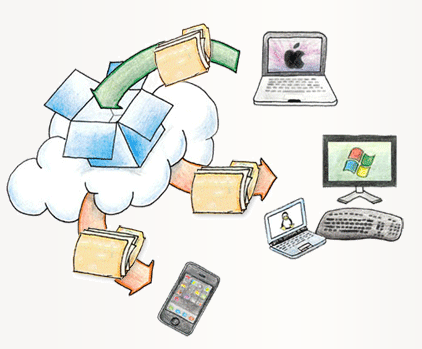
What is Dropbox? It is a personal cloud-base storage service (online backup file service) where you save you files (photos, documents, powerpoint presentations or any files you can think of) online. In addition, you can used it for file sharing and collaboration. The application is available on Microsoft Windows, Mac operating system. You can upload the application on your mobile as well – iPhone, iPad, Android, and BlackBerry devices.
Recently, a news about Dropbox tells they’d hit 175 million users, and daring to say they could replace the hard drive. The CEO Drew Houston said, “Today is about making life easier for all of you.”
But how did Dropbox start? Rajiv Eranki – the previous head of server engineering at Dropbox talks how Dropbox start during the RAMP conference. Rajiv joined in 2008 and left in 2011 for “new, different challenges” as he says. Dropbox only had 2,000 users, when Eranki joined the Dropbox team. He together with another person who had worked full time on the back end with just one database machine and one front-end server. Working with 2,000 users with only few people on the back-end doesn’t really provide efficiently. In addition, the first iteration of sharding on Dropbox was quite buggy
“would not have changed a thing” as the Dropbox company said but that scrappy and haphazard way have created some benefits. For instance, there is no need to write a special code when doing queries. And that “gained tremendous flexibility and scalability,” said Eranki.
They have used Python and it worked out perfectly well. By using Python “we could get to 40m users without having to write thousands of lines of C code.” The client app was also written in Python.
After taking a walk back through how Dropbox starts, Eranki made some startup lessons. He also shared some of the mistakes he did along with working on Dropbox.
Along the way, Rajiv Eranki together with his Dropbox team have found that “Being clever about architecture in advance is hard” and “scaling for us was more about prioritizing projects… and building process.”